
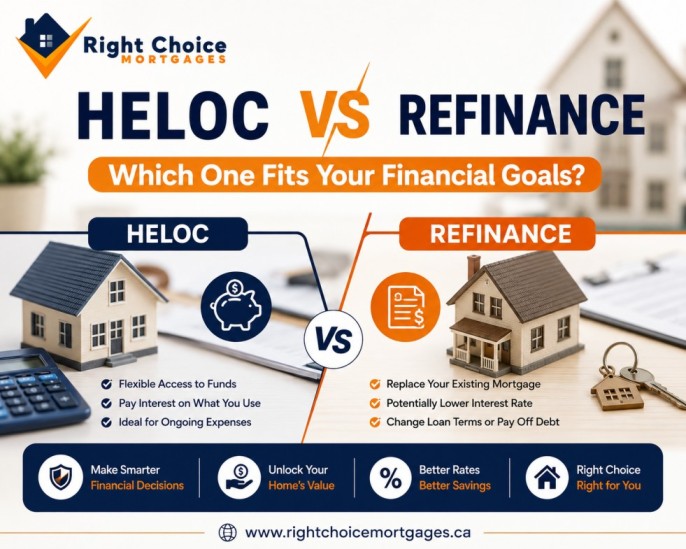
HELOC vs Refinance Which One Fits Your Financial Goals
Owning a home comes with more than just monthly payments , it also builds equity, and that equity can become a powerful financial tool when used wisely. But when homeowners decide to tap into that equity, they’re often stuck choosing between two popular options. HELOC vs Refinance is one of the most common questions Canadian homeowners ask when they want to access cash without selling their property. Both options let you borrow against your home’s value, but they work in very different ways, come with different costs, and suit different financial situations. In this guide, we’ll break down how each one works, when it makes sense to choose one over the other, and how to decide which path fits your personal goals.
What Is a HELOC and How Does It Work?
A Home Equity Line of Credit, or HELOC, works a lot like a credit card that’s secured against your home. Once approved, you get access to a revolving credit limit based on your available equity, and you only pay interest on the amount you actually use. This flexibility makes it a popular choice for people who need ongoing access to funds rather than a single lump sum. Many homeowners compare home equity line of credit vs refinancing because a HELOC allows them to borrow, repay, and borrow again without reapplying for a new loan every time.
What Does Refinancing Actually Mean?
Refinancing means replacing your current mortgage with a brand-new one, usually with different terms, a new interest rate, or a larger loan amount. When homeowners refinance to pull out equity, it’s often referred to as a cash-out refinance. Unlike a HELOC, refinancing gives you one lump sum upfront, and your entire mortgage balance is recalculated under the new agreement. This is why many people specifically search for HELOC vs cash out refinance, they want to know whether it’s smarter to get a whole new mortgage or simply add a credit line on top of their existing one.
HELOC vs Refinance for Home Improvements: Which Wins?
Home renovations are one of the biggest reasons Canadian homeowners tap into their equity. If your project timeline is uncertain or costs may change along the way, a HELOC gives you the flexibility to draw funds as needed instead of borrowing a fixed amount all at once. On the other hand, if you already know the exact renovation budget and want the stability of one predictable monthly payment, refinancing might be the better route. When comparing HELOC vs refinance for home improvements, the real deciding factor usually comes down to whether your project has a fixed cost or an evolving one.
Interest Rates: Fixed Stability vs Flexible Access
Interest rates play a major role in this decision. Refinancing typically offers fixed or lower long-term rates since it replaces your entire mortgage, which can be appealing if you want predictable payments for years to come. A HELOC, however, usually comes with a variable rate, meaning your payments can rise or fall depending on market conditions. If you’re someone who values certainty, a fixed-rate refinance may feel safer. But if you’re comfortable with some rate fluctuation in exchange for flexible borrowing, a HELOC could work in your favor.
Repayment Structure: What Fits Your Budget?
Refinancing comes with a structured repayment plan, similar to your original mortgage, spread out over a set number of years with consistent payments. A HELOC, by contrast, often allows interest-only payments during the draw period, which can lower your monthly obligation in the short term but may lead to a bigger balance later if you’re not careful. Homeowners weighing HELOC vs refinance should think honestly about their spending habits and whether they’d benefit from strict repayment discipline or prefer the freedom of flexible payments.
Closing Costs and Fees to Consider
Both options come with costs, but they aren’t identical. Refinancing usually involves higher upfront closing costs since you’re essentially taking out a new mortgage, including appraisal fees, legal fees, and potential penalties for breaking your current mortgage term early. A HELOC generally has lower setup costs, making it a more budget-friendly option if you don’t want a large expense right away. Before deciding, it’s worth calculating the total cost of each option over time, not just the upfront price tag.
When Should You Choose a HELOC?
A HELOC tends to make more sense when you need flexible, ongoing access to funds rather than a single large payout. It’s a strong fit for homeowners who are managing multiple smaller expenses, want an emergency financial cushion, or are working on a renovation project with costs that could change along the way. Because you only pay interest on what you actually borrow, a HELOC can also be a smart way to keep your monthly obligations lower during periods when you’re not actively using the funds.
When Should You Choose to Refinance Instead?
Refinancing is generally the better choice if you want to consolidate high-interest debt, lock in a lower fixed rate, or need one large lump sum for a specific purpose like a major purchase or investment. It’s also worth considering if your current mortgage rate is significantly higher than today’s market rates, since refinancing could reduce your overall interest costs. If predictability and long-term stability matter more to you than short-term flexibility, refinancing usually wins.
Making the Right Choice for Your Financial Future
There’s no single answer that works for everyone. The decision between HELOC vs refinance ultimately depends on how you plan to use the funds, how comfortable you are with variable interest rates, and how quickly you want to pay the money back. That’s exactly why working with an experienced broker matter. At Right Choice Mortgage, our team takes the time to understand your unique financial situation before recommending a solution, rather than pushing a one-size-fits-all product. Right Choice Mortgage has helped countless homeowners across Canada compare their options side by side so they can move forward with confidence instead of guesswork. Whether you’re leaning toward a HELOC or considering a full refinance, the team at Right Choice Mortgage is ready to walk you through the numbers and help you choose the path that truly fits your goals. If you’re still unsure where to start, reaching out to Right Choice Mortgage for a personalized consultation is often the simplest way to get clarity.
Frequently Asked Questions
1. Is a HELOC better than refinancing in Canada?
It depends on your goals. A HELOC offers flexibility and lower upfront costs, while refinancing offers fixed rates and a structured repayment plan. Neither is universally “better”, it comes down to your financial needs.
2. Can I get a HELOC and refinance at the same time?
In some cases, yes. Certain lenders offer combined mortgage and HELOC products, allowing homeowners to access both a fixed portion and a flexible credit line under one arrangement.
3. How much equity do I need for a HELOC in Canada?
Most Canadian lenders require homeowners to have at least 20% equity in their property before qualifying for a HELOC, though requirements can vary by lender.
4. Does refinancing hurt my credit score?
Refinancing can cause a temporary dip in your credit score due to the hard credit check involved, but scores typically recover within a few months if payments stay on track.
5. What is the maximum amount I can borrow with a HELOC?
In Canada, homeowners can typically borrow up to 65% of their home’s value through a HELOC, though this can be combined with your mortgage up to 80% total loan-to-value.
6. Is interest on a HELOC tax-deductible in Canada?
It can be, but only if the borrowed funds are used for investment or income-generating purposes. Using a HELOC for personal expenses like renovations typically does not qualify for tax deductions.
7. How long does it take to refinance a mortgage in Canada?
The refinancing process usually takes anywhere from two to six weeks, depending on the lender, appraisal timelines, and how quickly required documents are submitted.
Choosing between a HELOC and a refinance doesn’t have to be overwhelming. With the right guidance, you can make a decision that supports your financial goals today while setting you up for long-term success.
This article is for general informational purposes only and does not constitute professional mortgage or other financial advice. Always consult with a licensed financial professional for advice tailored to your specific financial situation. Right Choice Mortgages. assumes no liability for reliance on this content.
Get a Free Mortgage Consultation
Book Your ConsultationGet expert guidance tailored to your home financing needs.